
How Does a Distillation Unit Work? Industrial Applications
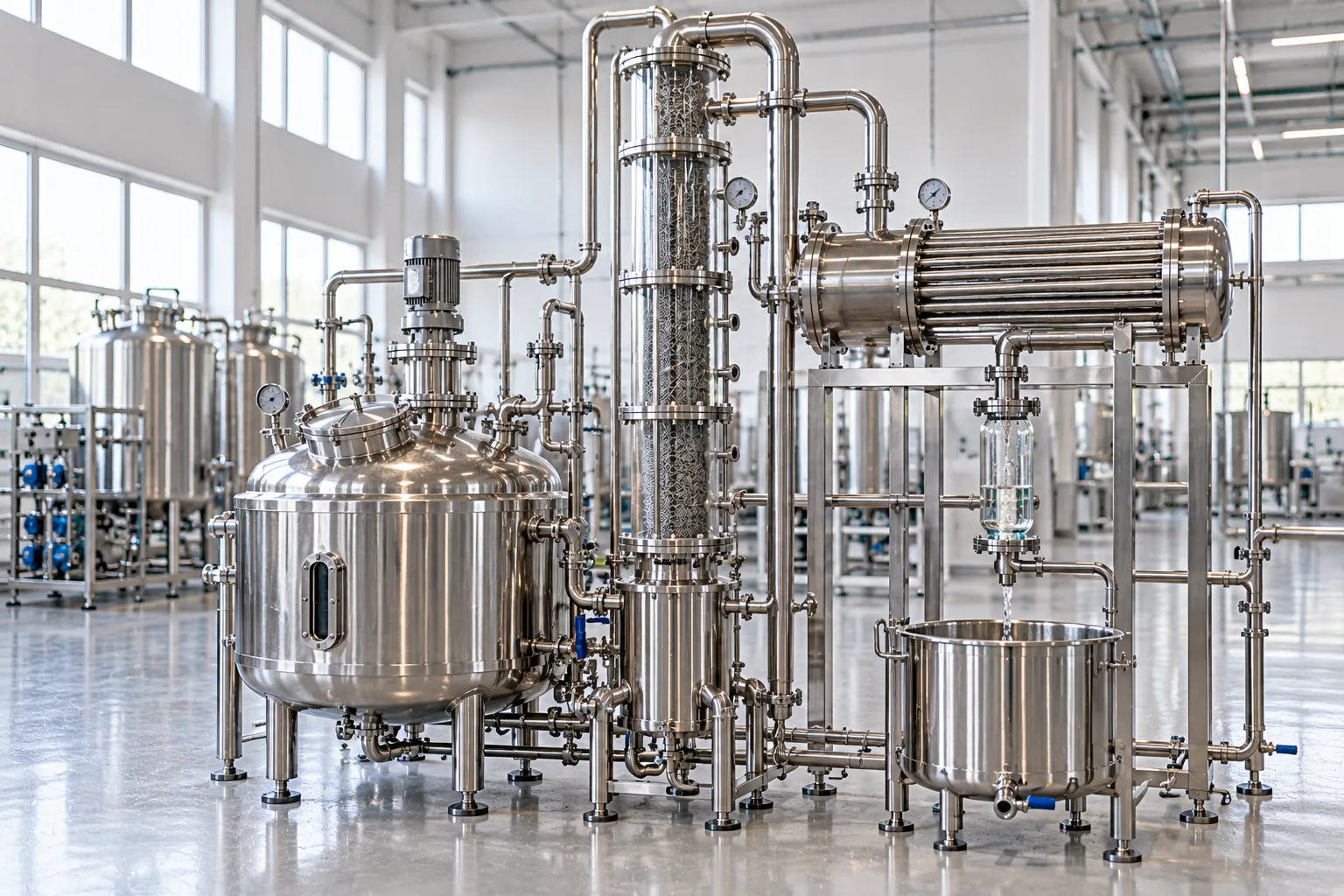
Distillation is the process of separating the components of a liquid mixture based on differences in their boiling points. It is used in many industries, from essence and flavor production to solvent recovery.
A distillation unit essentially consists of three sections: the boiler where the mixture is heated, the condenser where the vapor is condensed, and the receiver where the separated liquid is collected. In the heated mixture, the component with the lower boiling point evaporates first, cools in the condenser to turn back into liquid, and is collected separately.
Basic Types of Distillation
- Simple distillation: Used to separate components whose boiling points differ significantly from each other.
- Fractional distillation: Components with close boiling points are separated through repeated evaporation and condensation inside a column.
- Vacuum distillation: Lowering the pressure reduces the boiling point, allowing heat-sensitive substances to be separated without degrading.
- Steam distillation: Widely used to obtain plant oils and aromas.
Applications
- Production of essences, flavors and essential oils,
- Recovery and purification of solvents,
- Laboratory and pilot-scale production,
- Concentration processes in the food and beverage industry.
Design Considerations
- Material: Product-contact surfaces should be made of corrosion-resistant stainless steel,
- Heating control: Gradual and precise temperature control,
- Condenser capacity: The ability to condense all of the vapor,
- Safety: Pressure relief and suitable electrical equipment for flammable vapors.
You can review our distillation unit on its product page. For a custom design based on your capacity and process requirements, write to us.
Let's find the right solution for your project
Tell us what you need and we will propose the most suitable machine or manufacturing solution.