
What Is a Checkweigher and What Does It Bring to Your Production Line?
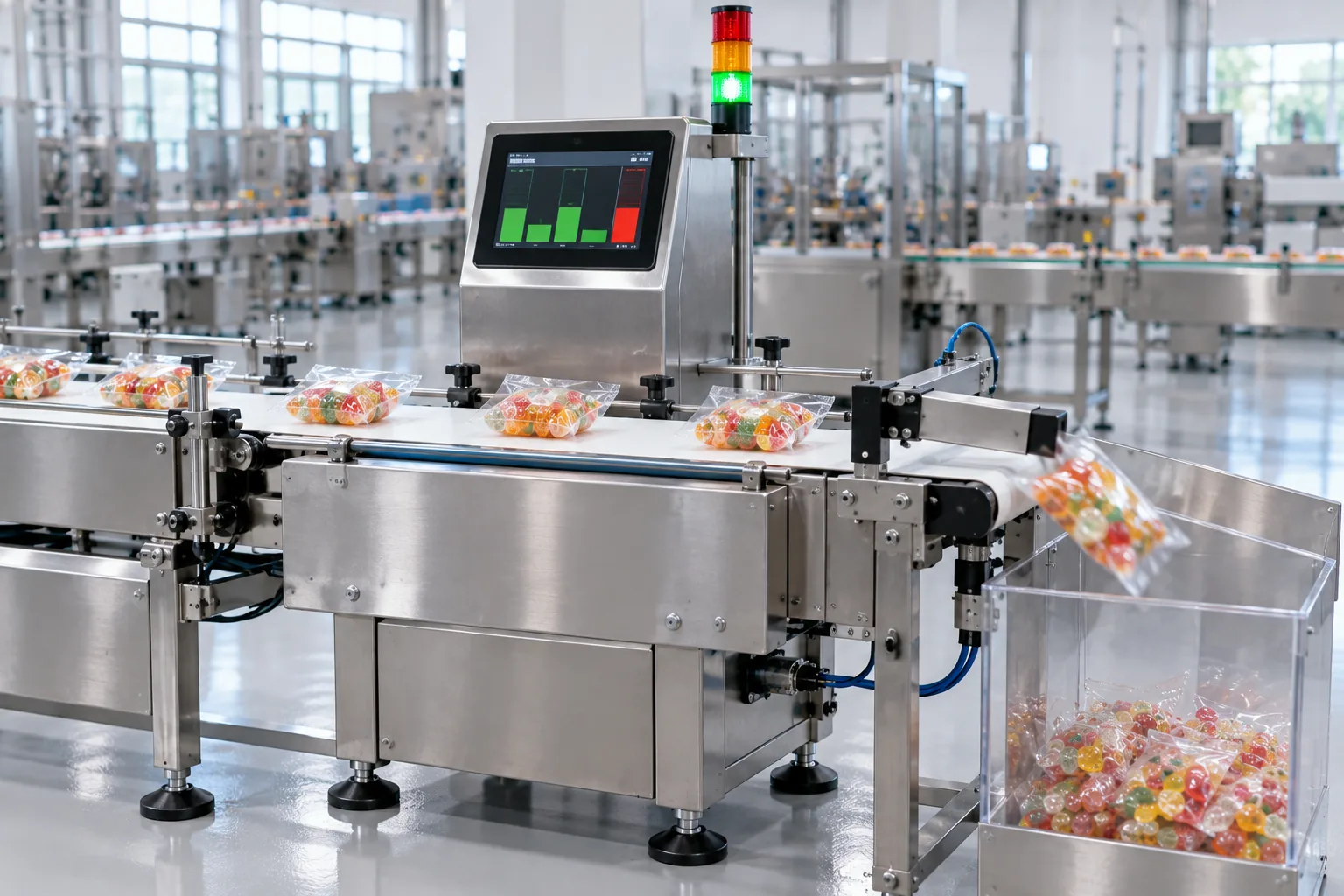
A checkweigher weighs every package moving along the belt without stopping it and rejects those whose weight is out of tolerance. It prevents consumer complaints caused by underfilling and product loss caused by overfilling at the same time.
For packaged products, delivering the quantity stated on the label is a legal requirement. Manual sampling does not check every package; a checkweigher, by contrast, weighs every product that passes through the line.
How Does It Work?
- Infeed belt: Products are spaced apart and fed into the weighing section.
- Weighing belt: A belt mounted on a precision load cell measures the weight as the product passes over it.
- Evaluation: The measured weight is compared with the lower and upper limits in the product recipe.
- Rejection: Out-of-limit products are removed from the line by an air blast, a pusher arm or a diverter flap.
What It Brings to Your Line
- Legal compliance: Underweight packages are kept off the market.
- Product savings: Overfilling becomes visible, and adjusting the filling machine reduces product giveaway.
- Feedback: When measurement data is sent to the filling machine, filling can be corrected automatically.
- Records: Batch-based weighing statistics serve as evidence in quality audits.
What to Consider When Choosing One
- Product weight and size range,
- Line speed (packages per minute),
- Required accuracy and ambient conditions (vibration, air drafts),
- Whether a locked bin is needed to collect rejected products,
- Use together with a metal detector.
You can review our checkweigher unit on its product page.
Let's find the right solution for your project
Tell us what you need and we will propose the most suitable machine or manufacturing solution.