
Crystallization, Stickiness and Air Bubbles in Hard Candy: Causes and Solutions
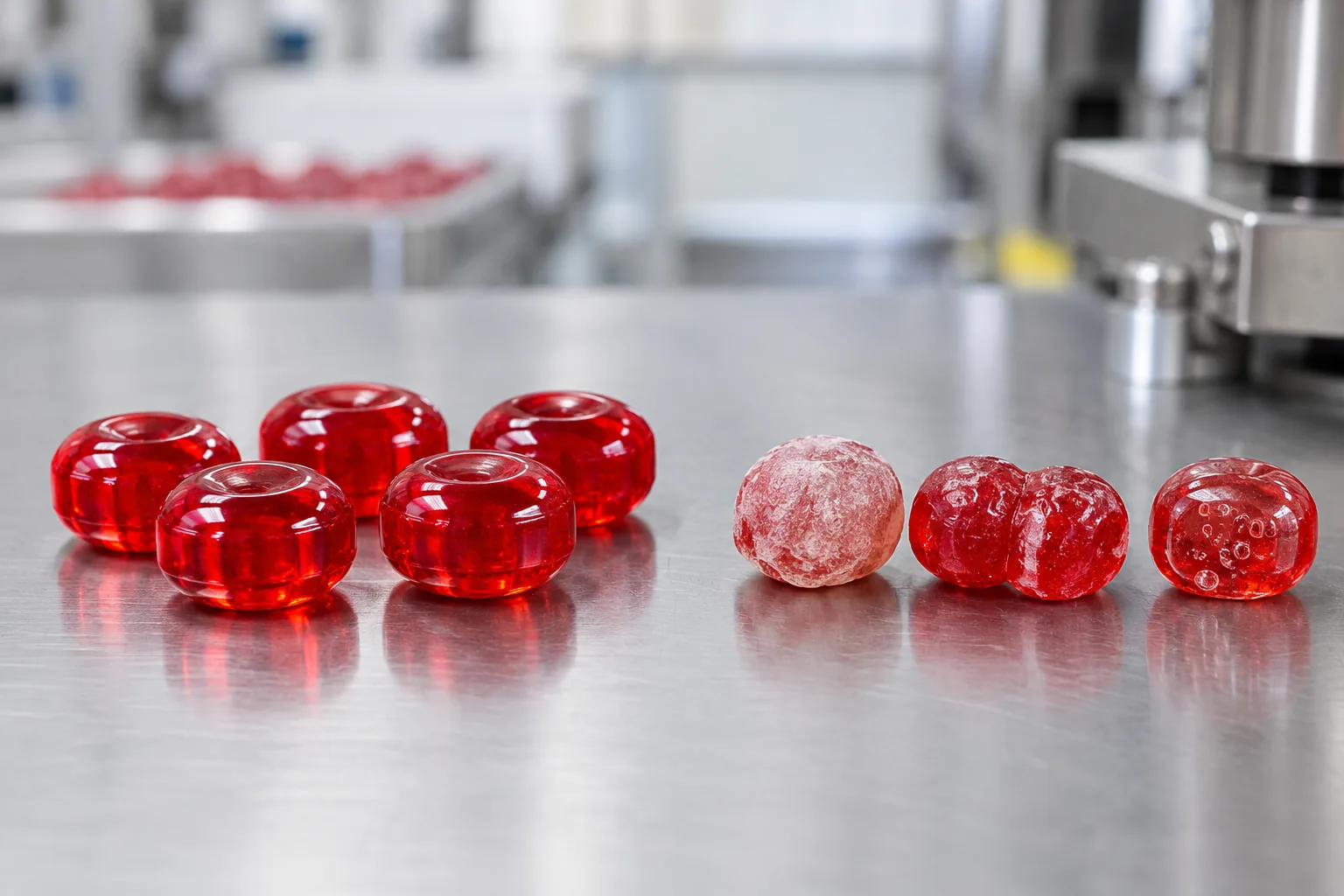
A dull surface, candies sticking together and products with trapped air bubbles are the three most common defects in hard candy production. Each has a different cause, and each solution lies at a different point on the line.
Defects in hard candy usually arise not from a single cause but from the combined effect of recipe, cooking and ambient conditions. The table below summarizes the three most common defects and where to look first.
| Defect | Symptom | Where to look first |
|---|---|---|
| Crystallization (graining) | The surface turns dull and the product becomes grainy and opaque | Glucose ratio in the recipe, holding time after cooking, sugar dust getting into the mass |
| Stickiness | Products stick to each other and to the wrapper | Residual moisture, ambient humidity, time between cooling and packaging |
| Air bubbles | Visible voids in clear products | Mixing method, pouring of the mass, dosing in the depositor |
Crystallization
Candy with a glassy structure tends to revert to ordered crystals when conditions allow. A single sugar crystal can act as a seed and trigger graining of the entire mass. That is why the cleanliness of the cooling table and the pulling arms is as important as the recipe. Holding the mass for a long time and reworking it repeatedly also increase the risk.
Stickiness
Hard candy is hygroscopic, meaning it absorbs moisture from the surrounding air. Candy that picks up moisture on its surface becomes sticky. To reduce stickiness:
- Residual moisture after cooking must be kept at the target value,
- Ambient humidity in the cooling and packaging area must be kept under control,
- The product must be packaged without delay after cutting,
- A packaging film with an adequate moisture barrier must be used.
Air Bubbles
In clear candies, bubbles directly spoil the appearance. Mixing the mass quickly or pouring it from a height traps air inside. On depositing lines, the setting of the dosing head and the pouring speed into the mold are decisive. Letting the mass rest after vacuum cooking also reduces bubbles.
The Importance of Keeping Records
The fastest way to trace the source of defects is to record the cooking temperature, time, ambient humidity and packaging time for each batch. Automatic collection of this data by the line automation makes it easier to see on which day and under which conditions the problem began.
You can write to us to evaluate a defect you are experiencing on your line together.
Let's find the right solution for your project
Tell us what you need and we will propose the most suitable machine or manufacturing solution.