
How Does a Hard Candy Production Line Work? Step by Step from Cooking to Packaging
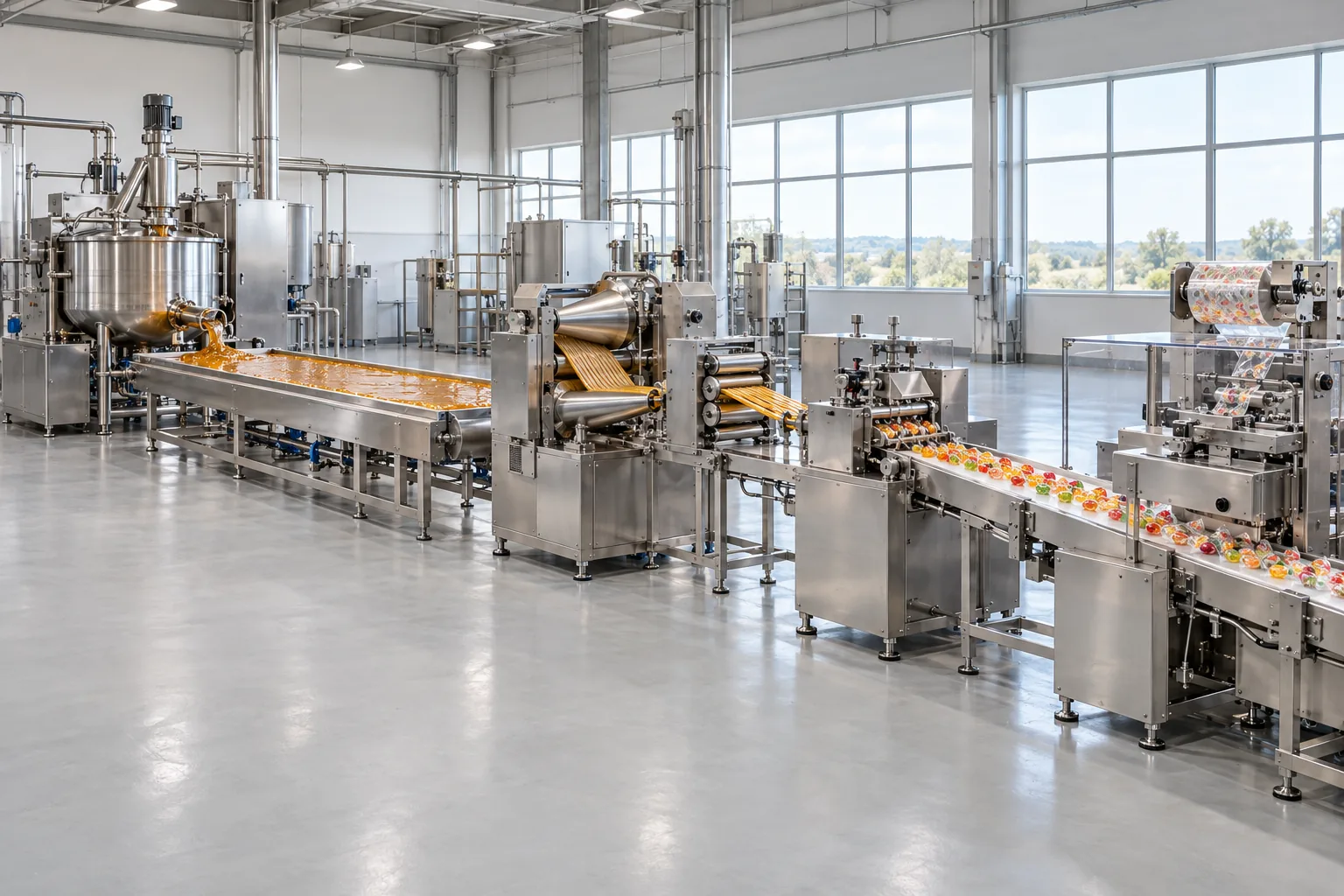
On a rope-formed hard candy line, the candy passes through a series of linked stations from the cooking kettle to the packaging machine. Knowing what each station does is the first step in choosing the right line.
Most traditional hard candies, lollipops and unfilled hard candies are produced by the rope-forming method: the cooked candy mass is cooled and kneaded, formed into a long rope, and this rope is cut into equal pieces. Below we describe the stations of a rope-formed line in order.
1. Cooking
Sugar, glucose syrup and water are cooked in a kettle to drive off the water. At the end of cooking, the moisture content and temperature of the mass directly determine the product's hardness and shelf life. That is why the kettle's heating control is one of the most critical points on the line.
2. Cooling Table
The hot mass is poured onto the cooling table and cooled until it reaches a kneadable consistency. Flavor, color and acid are usually added at this stage, and the mass is folded until it becomes homogeneous.
3. Pulling / Aerating
The mass is pulled and folded repeatedly in the pulling machine. As it takes in air, its color lightens and it gains a silky, opaque appearance. For striped candies, the clear mass and the pulled mass are combined after this stage.
4. Batch Roller and Rope Sizing
The batch roller turns the mass in a cone shape and feeds it forward as a single rope. The rope sizing machine then passes this rope through a series of sizing rollers, gradually reducing it to the desired diameter. The more consistent the rope diameter, the more consistent the weight of the cut pieces.
5. Cutting and Stick Inserting
The cutting unit divides the continuously flowing rope into equal pieces and gives the product its final shape. In lollipop production, the stick inserting station places a stick in each piece, so both traditional hard candy and lollipops can be produced on the same line.
6. Conveying, Cooling and Packaging
The cut products are transferred to the next station by conveyor. The cooling tunnel completes the hardening of the product, and the packaging machine wraps it in flow-pack or twist wrapping.
What to Look for When Choosing a Line
- Capacity: The hourly target output determines the size of all stations, especially the kettle and the packaging machine. The line runs at the speed of its slowest station.
- Product variety: If different rope diameters, shapes and lollipop production are required, the cutting and stick inserting stations should be selected accordingly.
- Hygiene: Product-contact surfaces must be stainless steel and easy to clean.
- Control: Being able to adjust speed and temperature settings from an operator panel speeds up product changeovers.
- Service: Sourcing spare parts and technical support from the same company shortens downtime.
You can explore the stations of our rope-formed line with live 3D models on the product page, and contact us for a line that matches your capacity.
Let's find the right solution for your project
Tell us what you need and we will propose the most suitable machine or manufacturing solution.