
Choosing Conveyors for Food Production: Belt Types and Z Conveyors
Conveyors may look like simple equipment that carries product between stations, but a poorly chosen conveyor can crush the product, slow down the line or make cleaning difficult.
On a production line, a conveyor's job is not just to carry product: it guides, spaces, accumulates or transfers it from one level to another. The product's characteristics and hygiene requirements are decisive in the selection.
Common Belt Types
| Belt type | Key feature | Typical use |
|---|---|---|
| PU / PVC flat belt | Smooth surface, quiet operation | Conveying unpackaged product |
| Modular plastic belt | Durable, replaceable section by section, easy to clean | Washdown areas, heavy products |
| Stainless steel wire mesh belt | Heat-resistant, air-permeable | Cooking, cooling and drying |
Z Conveyor (Elevator)
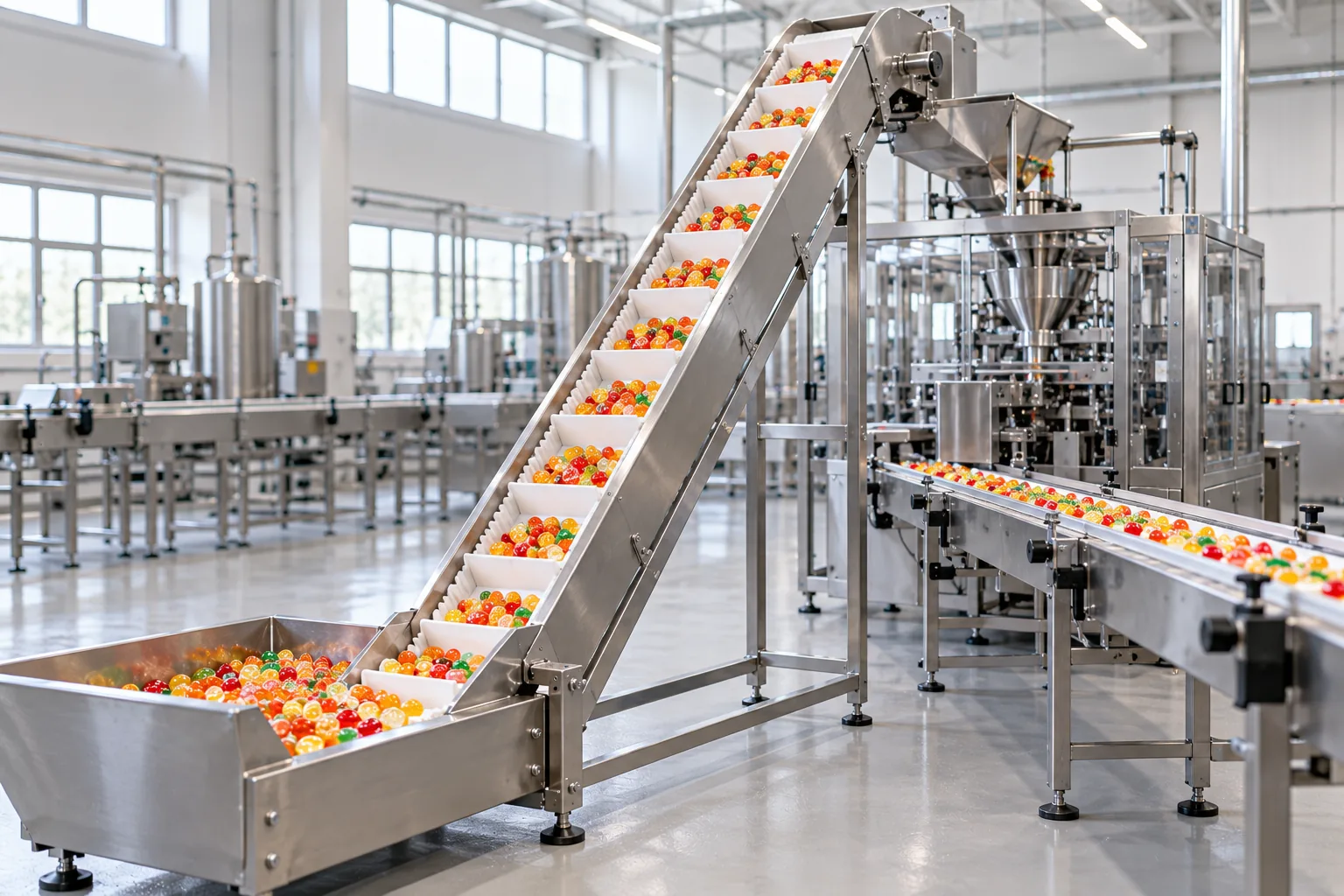
Z conveyors pick up product at a low level, raise it along an inclined section and deliver it horizontally at the top. They are used to transfer product from one machine to another with a higher infeed — for example, from cutting to the cooling tunnel or into the hopper of the packaging machine. Flights (cleats) on the belt keep the product from sliding back on the inclined section.
What to Consider When Choosing
- Product characteristics: For sticky, fragile or hot products, the belt material and transfer points are chosen accordingly.
- Speed synchronization: Conveyor speed must match the upstream and downstream machines; a VFD drive makes this adjustment easier.
- Hygiene: Food-grade belt, easily removable side guards and a frame that does not trap dirt.
- Safety: Pinch points must be guarded and emergency stops must be accessible.
You can review our conveyor on its product page.
Let's find the right solution for your project
Tell us what you need and we will propose the most suitable machine or manufacturing solution.